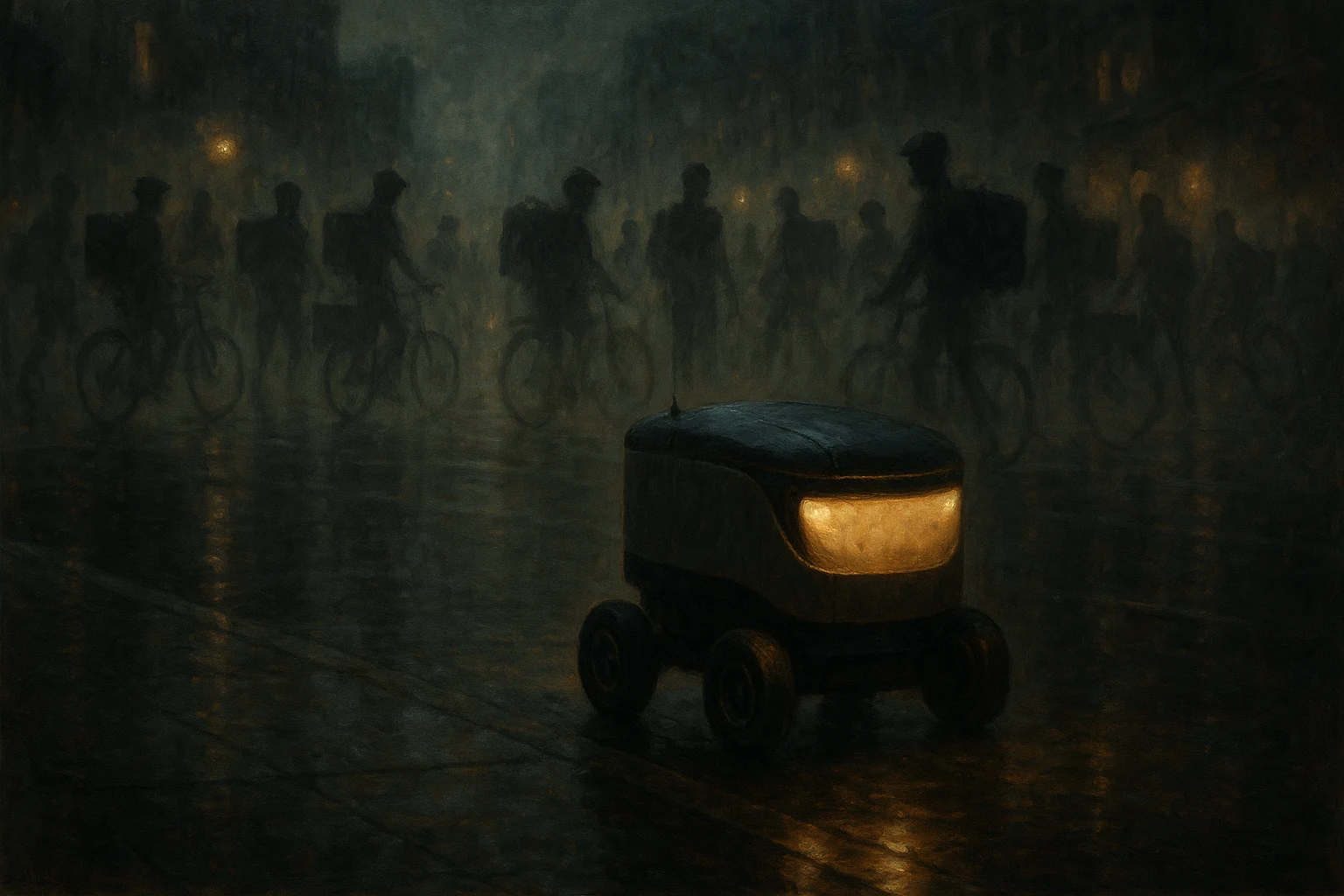
Walking through Jersey City recently I passed one of those four-wheeled lockbox robots making a delivery. Small thing, maybe knee-high, trundling down the sidewalk with purpose. I watched a woman receive an Amazon package from it — she opened the box with her phone, pulled out whatever she'd ordered, and I chatted with her briefly after. It was her first time. She seemed surprised at how easy it was.
She shouldn't have been surprised. The robot was always coming.
Netflix Didn't Mail DVDs Because It Wanted To
Netflix launched in 1998 mailing DVDs in red envelopes. For a decade, that was the business. Warehouses, logistics, physical media, postage. It looked like a better Blockbuster.
It wasn't. Netflix was a streaming company that didn't have enough bandwidth yet. The DVD business was a bridge — a way to build subscribers, habits, and a content library while waiting for the infrastructure to catch up. When broadband penetration crossed the threshold where streaming was viable, the transition happened fast. They didn't mail DVDs because it was the plan. They mailed DVDs because it was what was possible until the plan was possible.
Uber is the same architecture.
When Uber launched in 2010, self-driving cars were a DARPA research project. The technology to put a robot in the driver's seat didn't exist at commercial scale. So Uber did what Netflix did: they built the business using the bridge technology available. Human drivers. Millions of them, worldwide, brought into a gig relationship that looked like employment without any of its protections. The app, the ratings, the route optimization, the dynamic pricing — all of it was infrastructure for a business that was always going to run without the human in the front seat.
The robotaxi rollout is uneven and slower than optimists projected. But it is happening. Waymo is running hundreds of thousands of commercial trips monthly in multiple US cities with no safety driver. The cost curves are moving in one direction. Uber knows this — they've invested in AV technology while simultaneously running a human driver network that serves as their bridge.
When the bridge is no longer needed, the people on it don't get to stay.
The Safety Net That Was Always a Scaffold
The gig economy was sold as the new labor market — flexible, democratic, opportunity for anyone with a car and a smartphone. And for a period, it was a real economic lifeline for people displaced by earlier automation waves. The factory worker who lost their job in 2010 could drive for Uber. The retail worker whose store closed could deliver for DoorDash. The administrative assistant whose position was eliminated could do TaskRabbit.
These weren't great jobs. No benefits. No stability. Algorithmic management. Rates that declined as more drivers flooded the market. The platform took its cut first. But they were income. For a lot of people in a difficult decade, they were the floor.
They were never meant to be permanent. Not by the platforms.
The delivery robots multiplying on American sidewalks are the gig economy's destination. Starship Technologies, Amazon Scout, the Kiwibot, the sidewalk lockboxes appearing on blocks across Jersey City and San Francisco and Austin — they are the Uber app without the driver. The infrastructure that gig workers built — the customer habits, the density, the logistics networks — is the infrastructure these robots are inheriting.
The woman who was surprised at how easy it was? That's adoption. That's the consumer accepting the transition. Within five years, the surprise runs the other direction: getting a delivery from a human will feel slightly odd.
What Comes After the Bridge
In every prior technology wave, the bridge lasted long enough for the economy to partly adapt. Steam gave way to electrification over decades. Film cameras gave way to digital over a decade and a half. Each bridge had duration — enough time for displaced workers to find the next thing, for new sectors to partially emerge.
The gig economy bridge is shorter than people understood when they were on it. The autonomous vehicle technology that will pull it away wasn't ten years out when Uber launched — it was maturing in parallel. The delivery robot technology was maturing in parallel. The coffee shop barista robot, the warehouse robot, the physical labor automation that Boston Dynamics and its competitors are racing to deploy — all of it maturing together, converging on the last sector that displaced knowledge workers were supposed to fall back on.
Part 2 of this series said: every wave displaced workers who had fewer options than the previous cohort. The gig economy was the penultimate step. The people who drove to survive — after the factory closed, after the store closed, after the office restructured — are being displaced again. This time from the thing that was their floor.
The robot in Jersey City is not a curiosity. It is a data point in a trend that ends at the same place: the escalator with no next step.
The bridge was always transitional tech.
— J.P. Howlett
The Econolypse series: Part 1 · Part 2 · Part 3 · Part 4: Tell Me I'm Wrong
On Covenant: The Only Question Is How Long — the same argument from inside the work. I used to joke about Siri. A decade. Maybe less.
Sources
- Robot Workers Rising: How AI May Drive General-Purpose Autonomy in Robotics — Ars Technica
- Waymo One Ridership and Expansion Data — Waymo
- Gig Economy and Labor Market Flexibility — Brookings Institution