
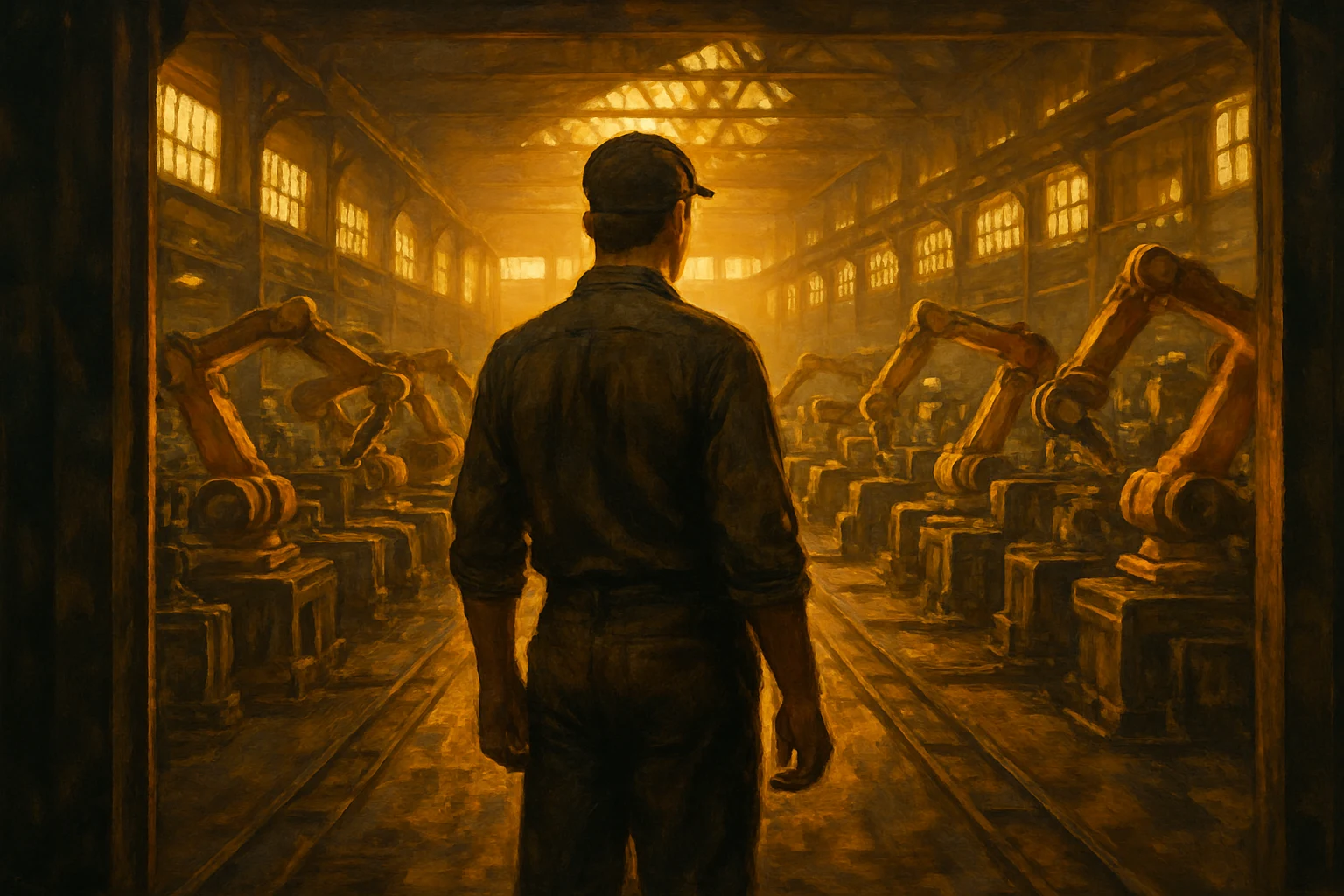
People keep comparing this to offshoring. That comparison is wrong in a way that matters.
Offshoring steel production was bad — it hollowed out communities, concentrated pain on specific regions, and the promised transition to "better jobs" mostly didn't happen for the people who lost the original ones. It was damaging and it was real.
But it moved the work. Someone in another country was still doing the job. The function still existed. The human labor still had a destination.
What's coming doesn't move the work. It ends it.
The Next Decade
Watch.
Clerical jobs first — data entry, processing, scheduling, basic case management, document handling. The cognitive overhead of keeping the paperwork moving has already been automated in pilots at every major institution. The rollout is underway. It's not visible in the aggregate data yet because transitions lag, but the decisions are made. The headcount is not coming back.
Trucking. Three and a half million drivers in the United States. The autonomous systems are ready. What's holding it back is regulatory, not technical — and regulatory timelines collapse fast once the liability math shifts. When an autonomous truck has a better safety record than a human one, the question reverses: who's liable for choosing the human?
Assembly line work. This one's been in motion for decades, but AI-guided robotics is accelerating the final phase — the tasks that required human dexterity and judgment, the edge cases that stopped full automation, are falling. The last holdouts are going.
Fast food. This one's more poised than almost anyone admits. The physical requirements are standardized, the workflow is repeatable, and the margin pressure in the industry is extreme. The first fully automated unit that can match speed and consistency will trigger a wave of capital deployment that makes the transition fast. Grocery stores already have security robots. Self-checkout has been normalizing the customer-as-checkout-clerk model for twenty years. The store clerk is not a growth occupation.
These are not fringe categories. They are the largest employment sectors for people without a four-year degree. Combined, they represent tens of millions of workers in the United States alone. Globally, the number is in the hundreds of millions.
This Isn't Weather
Previous disruptions — steam, electrification, the internet, offshoring — arrived like weather. Damaging, disorienting, but recoverable. The economy adapted. New job categories emerged. Human labor found a floor.
The floor in every previous disruption was this: machines automate specific tasks, but they still need humans to direct them, maintain them, and fill the categories they can't handle. The fallback was always physical or cognitive work that machines couldn't yet do.
AI eliminates the cognitive fallback. Robotics eliminates the physical one. They're arriving at the same time. There is no third category.
Power structures are going to shift. They always shift at the hinge points. The question isn't whether — it's who captures the surplus.
The people who've been watching closely — who've seen the autonomous grocery-store robot, who understand what the current generation of models can already do with a well-structured brief — know that what's visible now is not the destination. It's the departure.
Quantum and AI
Here's the piece almost nobody is accounting for yet: what happens when quantum computing enters the equation.
The current wave is AI applied to classical computing infrastructure. That's already transformative — we're living it. But quantum computing breaks the current limits on what computation can find, model, and decrypt.
Quantum plus AI means the end of hiding in obscurity. The hidden asset structures, the layered shell companies, the encrypted communications, the institutional corruption that survives on complexity and friction — all of it becomes findable. Truth gets laid bare in ways it has never been laid bare before.
That's not just an economic prediction. It's a power-structure prediction. Institutions that currently operate with impunity because the information needed to hold them accountable is too fragmented, too encrypted, or too buried to surface — those institutions are operating on borrowed time. The combination of AI's pattern recognition and quantum's computational reach will eventually find what's hidden.
This is where the tidal wave metaphor gets its full weight. The Reach series describes two doors: a future where the surplus is distributed and humanity uses it to expand — and one where concentrated control of the new infrastructure produces neo-feudalism with better hardware. The quantum layer changes the calculus on the second door. You can't build a stable neo-feudal order on secrets that can be found.
What You Do With This
The individual opportunity is real. The tools that are displacing the clerical worker and the assembly line operator are the same tools that let the dreamer build their own structure without a hundred employees. The first wave is already here, and it favors the person who sees it.
But the window is not permanently open. The people who are building now — building their own structure, developing fluency with the multiplier, learning to direct AI as a workforce rather than a tool — are running ahead of a wave that is going to catch everyone eventually.
This isn't some little rebalancing. It isn't offshoring in a different industry. It's the largest restructuring of human labor since the Industrial Revolution, accelerating toward a second phase that will restructure information and power in ways we haven't yet started to model.
We're at the beginning.
— J.P. Howlett
Sources
- Bureau of Labor Statistics — Truck Drivers
- A.I. Is Reshaping the Economy. Good Luck Measuring How. — NYT Business
- The Reach, Part II: No Way Back — covenant.to
- You Ain't Seen Nothing Yet — covenant.to