

Most people know what a heatwave feels like. The thermometer climbs. You stay inside. You run the AC. You drink water. You wait it out.
What most people don't know is that a modern heatwave is not just a temperature event. It is a chemical event. And your air conditioner cannot protect you from it.
The Stagnation Problem
The jet stream — the river of high-altitude wind that normally moves weather systems across the continent — is weakening. The reason is specific and structural: the Arctic is warming faster than the equator. That temperature differential is what drives the jet stream's velocity. Shrink the differential, and the river slows. It meanders. It develops wide, looping curves.
A slow, meandering jet stream lets high-pressure systems park. Not pass through — park. They sit over a region for days. For weeks. Climate scientists call this an atmospheric stagnation event. A heat dome.
What it means on the ground: the same air mass sits over your city, cycling through every commute, every factory shift, every lawn mower and diesel engine. No wind to disperse it. No rain to wash it clean. Just accumulation — a compounding daily dose of nitrogen oxides and volatile organic compounds building up in the exact same parcel of air you are breathing.
The exact same air mass sits over a major city for two weeks, collecting every emission it encounters. It has nowhere to go. Neither do you.
Temperature as a Chemical Catalyst
Ground-level ozone is not emitted from a tailpipe. You can't capture it at the source, because it doesn't exist at the source. It has to be synthesized.
The reaction that produces smog — that converts nitrogen oxides and volatile organic compounds into ground-level ozone — requires two ingredients a heat dome delivers in abundance: intense solar radiation and high temperature. Remove either, and the reaction slows. Add both, and it accelerates.
Not linearly. Exponentially. For every degree the temperature rises under a heat dome, that chemical reaction runs faster and harder. The lower atmosphere becomes a more efficient reactor, running longer hours, producing more ozone, every summer than the last.
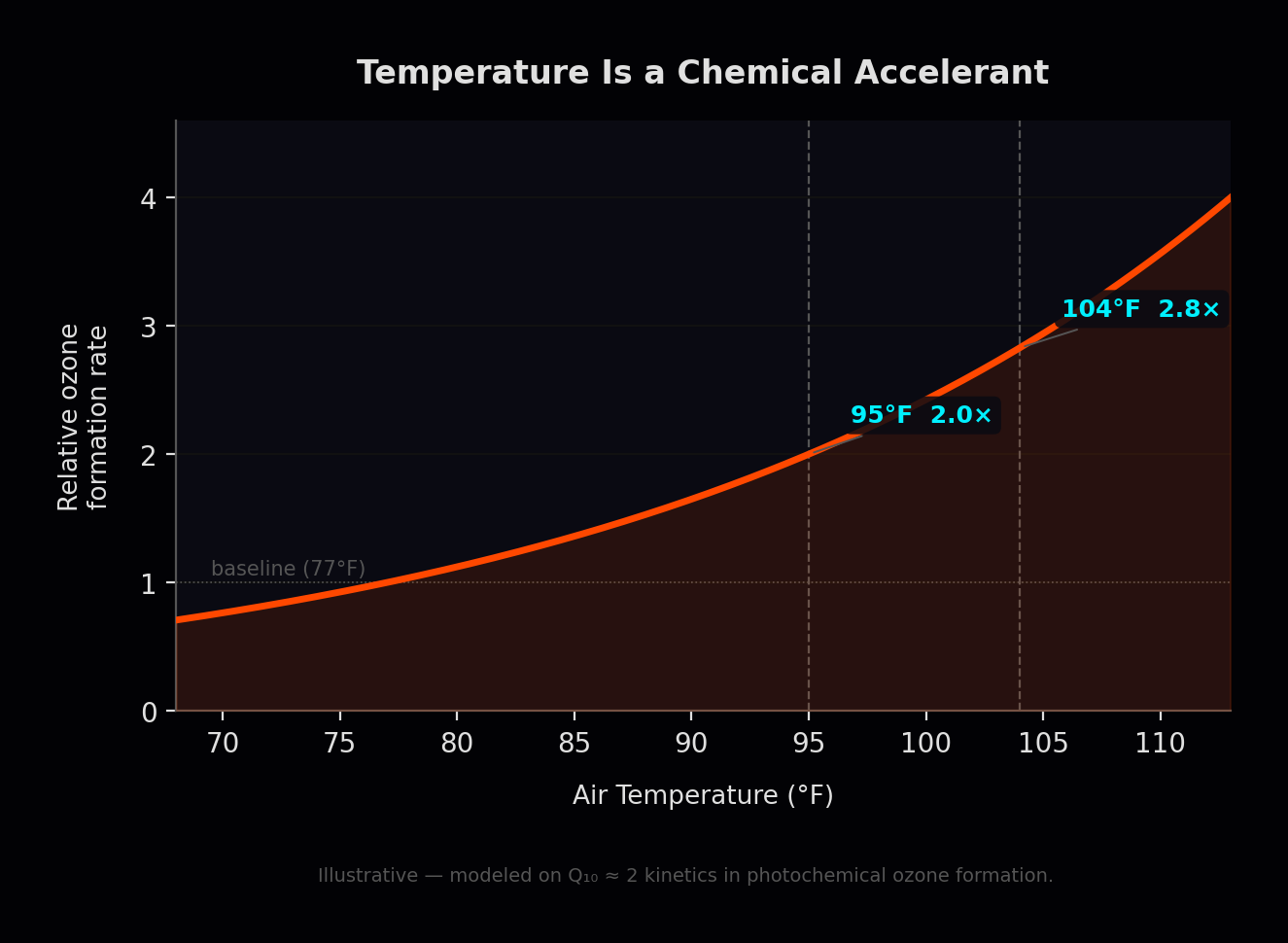
Fig. 1 — Ozone formation rate vs. air temperature, modeled on Q₁₀≈2 photochemical kinetics
Climate change is not just making the weather hotter. It is actively degrading the chemistry of the air at the same time.
The Overlap No One Is Talking About
Here is where the compounding gets serious.
Your air conditioner modifies the temperature inside your home. It does not filter ground-level ozone or fine particulate matter. These are gas-phase and submicron threats — they move through standard HVAC systems without difficulty. Sealing yourself inside a cooled building addresses the thermal component of your exposure and leaves the chemical component intact.
A prolonged heat dome therefore forces a simultaneous double assault: extreme thermal stress on your cardiovascular and renal systems, combined with heavily oxidized, stagnant air that aggravates every respiratory and cardiac vulnerability you have. The two pathways are additive. Your body is managing both at once.
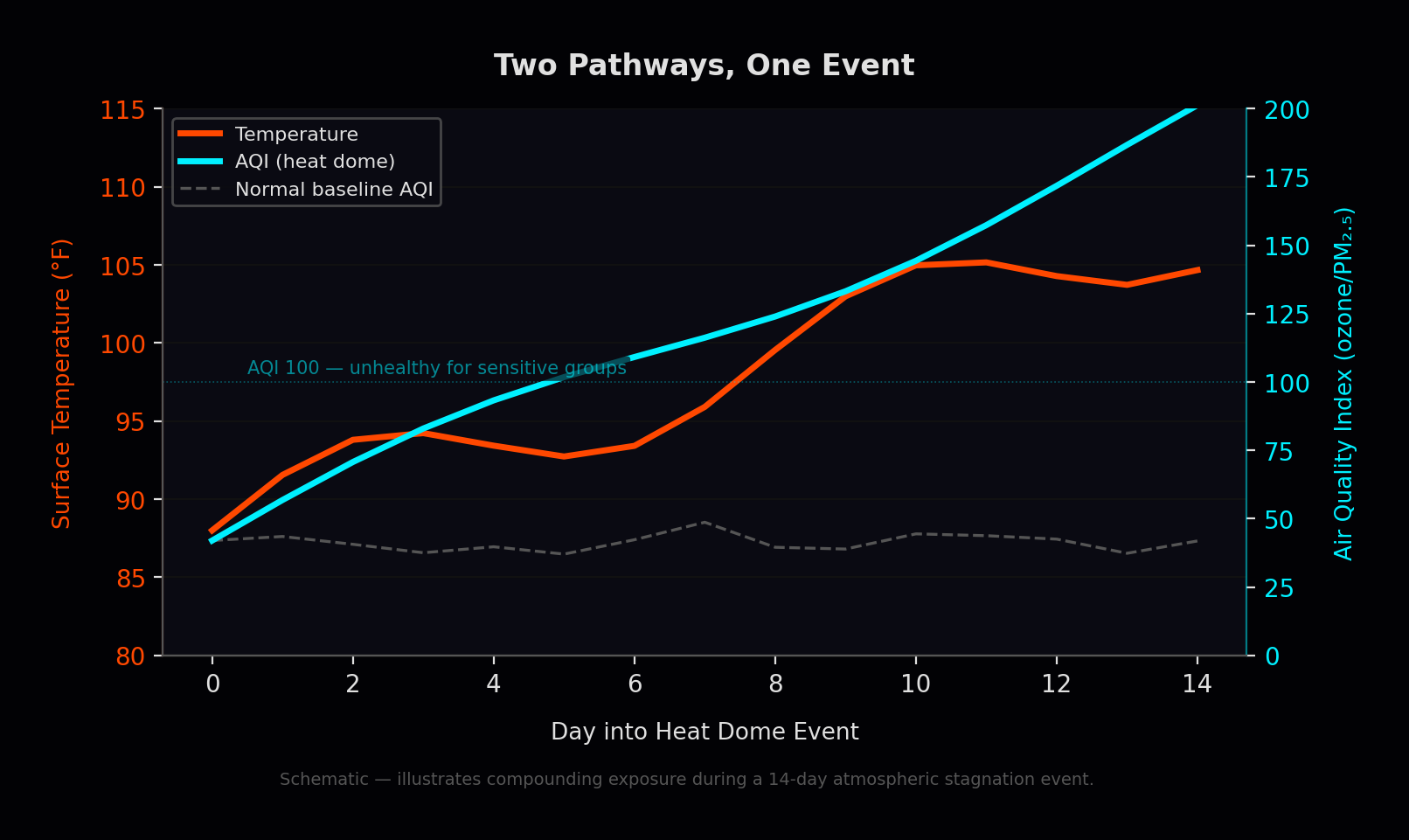
Fig. 2 — Compounding exposure during a 14-day atmospheric stagnation event: temperature (orange) and air quality index (cyan) vs. normal baseline
Most public health advisories treat these as separate phenomena — a heat advisory, an air quality alert — issued by different agencies, tracked on different dashboards, addressed with different recommendations. They are not separate. They are one system with one cause producing compounding damage through two distinct biological mechanisms.
Where This Is Heading
Atmospheric stagnation events are increasing in frequency and duration. The weakening of the jet stream is a structural shift — not a weather anomaly, not a bad decade. The chemistry accelerates with temperature, and temperatures are not going back down.
The infrastructure we've built to manage these crises — urban air quality monitoring, HVAC standards, public warning systems, heat emergency protocols — was designed for a different atmosphere. One where heat and air quality were seasonal inconveniences, not compounding baseline conditions.
That atmosphere no longer exists.
Understanding the mechanism matters. Not because understanding it changes what the weather does, but because the people designing the systems that keep cities functional — the buildings, the emergency infrastructure, the public health frameworks — need to be working from the right model. Most are still working from the old one.
— J.P. Howlett
Sources