
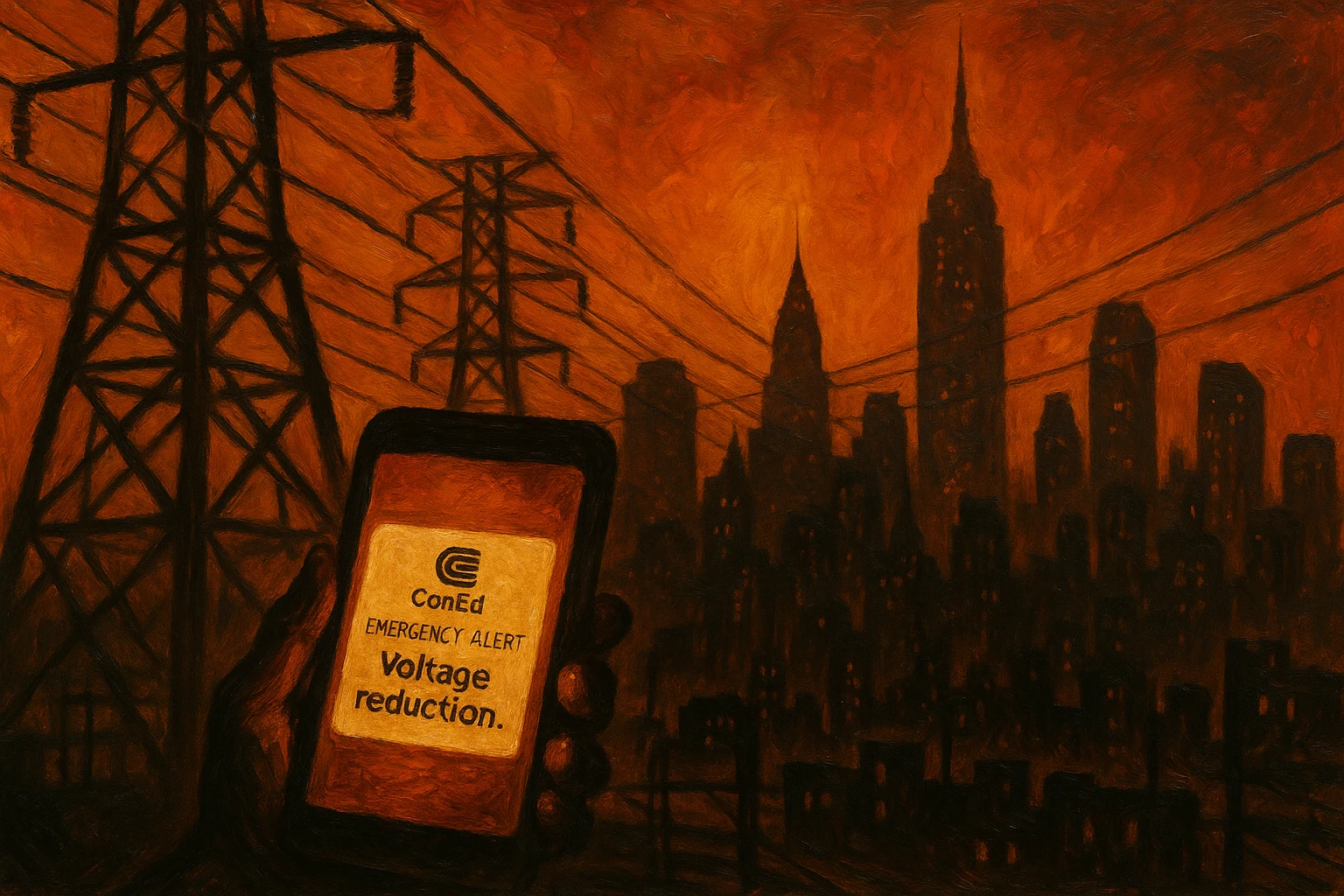
My girlfriend's phone buzzed on the Fourth of July.
ConEd. A conservation alert. They were reducing voltage in Queens — 8 percent, borough-wide — to protect equipment under the heat load. Don't run the dryer. Limit the AC. If you have two units, pick one.
It was the kind of message you read once and forget about, because what are you going to do.
But we'd been building a news queue when it came in. And the story at the top of that queue was about data centers being ordered to run on diesel generators to keep the Eastern Seaboard's lights on.
Same heat wave. Same grid. Same day.
What "Voltage Reduction" Actually Means
Eight percent doesn't sound like much.
The grid is designed for tolerances. Your appliances, your HVAC, your refrigerator — they're built to operate across a range of input voltages. An 8% reduction keeps everything technically functional while pulling roughly 8% less load from the system. It's a controlled brownout. It's ConEd telling the grid: we need to buy some time.
What they needed time to fix: equipment failures. Transformers and feeder cables overheat at sustained loads. Temperatures in New York hit 100°F on July 3rd — heat index 110 to 115. The infrastructure was not designed for sustained operation at those temperatures under those loads.
9,800 customers in southwest Queens — Howard Beach, Ozone Park, Richmond Hill, South Ozone Park — didn't get voltage reduction. They lost power entirely while crews replaced failed equipment. ConEd set up dry ice distribution at Resorts World in Jamaica. Eighty thousand customers across the city lost power in the 24-hour peak window.
The voltage reduction affected roughly 400,000 customers across Brooklyn and Queens alone. Nearly half the combined borough population.
This is not an anomaly. This is the system running at its design limits, and then past them.
Who's Eating the Power
While ConEd was managing the Queens failures, the grid operator for 13 states — PJM Interconnection, which runs the Eastern Seaboard from New Jersey to Illinois — was staring at a record demand projection: 166,304 megawatts. A new all-time peak. The previous record was set in 2006.
Then the supply side took a hit too.
New York City had been counting on a new transmission line from Quebec — it came online this spring and was expected to provide up to 20 percent of the city's power. On Wednesday and Thursday morning, at the exact peak of the heat wave, that line stopped delivering electricity. A converter station repair had "triggered a secondary issue," Hydro-Québec said. By Thursday afternoon it was back online.
Twenty percent of the city's power. Gone. On the hottest day in two decades.
New York City already gets most of its electricity from burning fossil fuels — not because of a shortage of renewable energy in the region, but because there isn't enough transmission capacity to bring it in from where it exists. During the peak, more than 60 percent of the statewide grid was running on oil and gas. The rest of New York has access to nuclear and renewable sources. The city doesn't, because the wires to carry that power were never built.
To hold the grid, Energy Secretary Chris Wright ordered PJM to do two things that don't normally happen.
First: force large data centers — any facility drawing 50+ megawatts — to switch from grid power to their diesel backup generators. The order specifically named "AI and cloud-computing campuses." Backup generators that could power dozens of large data centers, Wright noted, sit idle most of the time.
Second: allow power plants to exceed their pollution limits. Sulfur dioxide. Nitrogen oxides. Carbon monoxide. Ammonia. All permitted to run over, in the interest of keeping the grid alive.
The order expired at 11:59 PM on July 3rd.
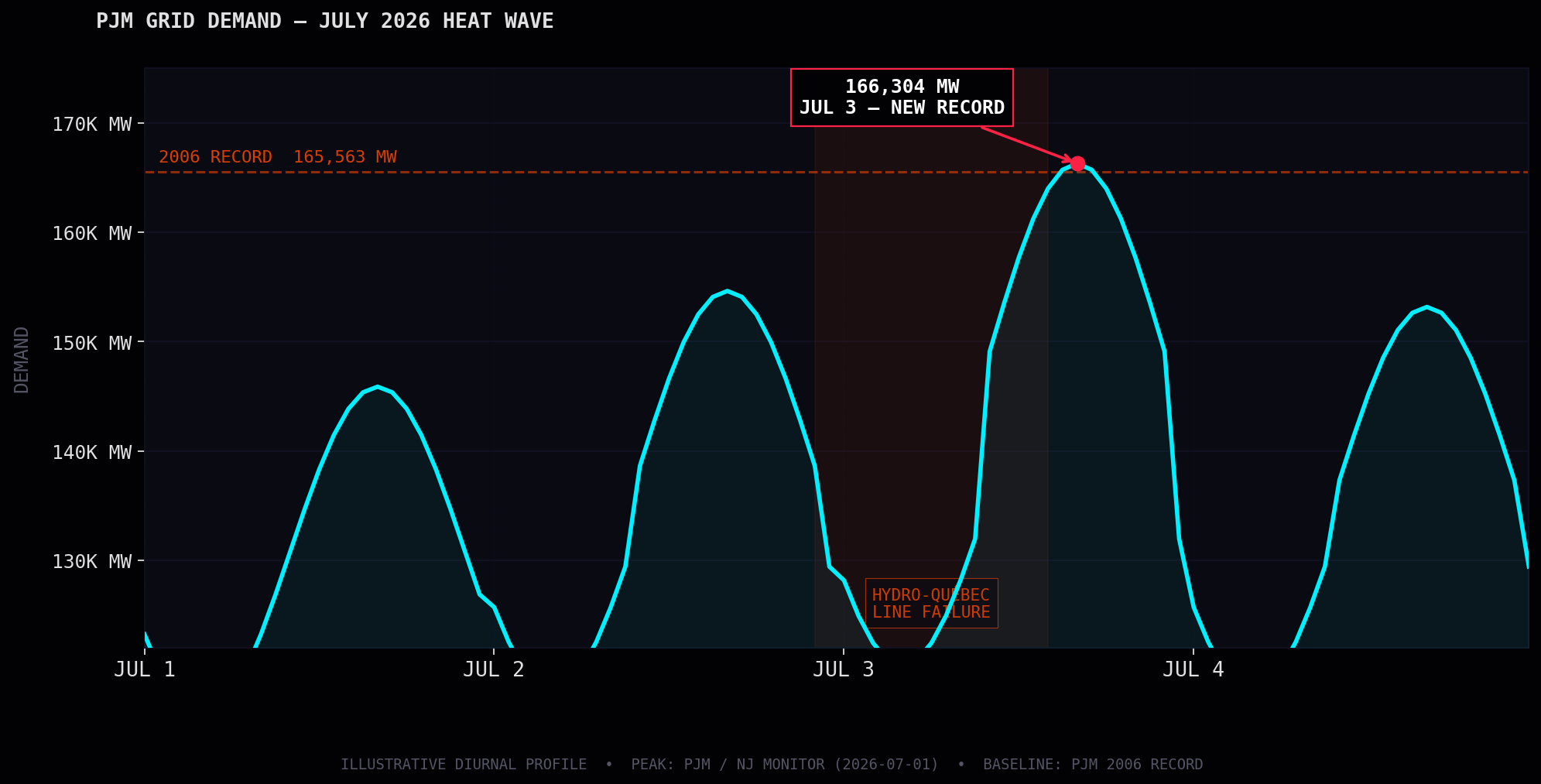
Fig. 1 — PJM grid demand July 2026. Thursday July 3 peak: 166,304 MW — a new all-time record, surpassing 165,563 MW set in 2006.
The Loop
Here's the part worth sitting with.
The first piece in this series explained what heat domes do to your air. The short version: a stalled jet stream parks the same air mass over a city for weeks. Temperature acts as a chemical catalyst, converting nitrogen oxides and volatile organic compounds into ground-level ozone at an exponentially faster rate. The air becomes a reactor. Your AC doesn't filter it.
The emergency order just added more feedstock to that reactor.
Energy experts flagged this immediately. Extensive use of backup generators at data centers, they warned, "could significantly increase air pollution in residential areas." Backup generators run on diesel or natural gas and emit more nitrogen oxides, particulate matter, and other pollutants than large power plants — and far more than the solar and wind farms they were substituting for.
The diesel generators running at every AI campus along the Eastern Seaboard are a primary source of the nitrogen oxides that heat domes convert to ozone.
There is a closed loop here that no one is naming:
- AI infrastructure requires massive, uninterruptible power
- Heat waves push grid demand to record highs
- Record demand pushes data centers onto diesel backup
- Diesel exhaust feeds the ozone chemistry
- The heat dome converts that exhaust into the air you breathe
- The same heat that created the demand spike makes the conversion more efficient
AI is on both sides of this equation. It is a significant driver of the demand stressing the grid. When the grid can't hold, the backup plan is diesel. Diesel produces the precursors for the air quality emergency that the heat dome is already building.
In a heat dome, NOx is not an acceptable trade-off. It's an accelerant.

Fig. 2 — The feedback loop: AI grid demand, diesel fallback, and heat dome ozone chemistry.
Where This Is Heading
California hasn't had to ask residents and businesses to conserve electricity during heat events for several years. The reason is specific and structural: California built battery storage. Thousands of shipping-container-sized battery arrays that absorb excess renewable energy and push it back during peak demand. Not a climate miracle — an infrastructure decision.
PJM made a different decision. It has been slow to add battery storage. So this week, when demand threatened to set a record, the answer was diesel generators at data centers and pollution exemptions for power plants — not batteries that were quietly charged overnight.
That's a policy choice. It looked like inaction until it became an emergency order.
The heat dome article closed with: The infrastructure we've built to manage these crises was designed for a different atmosphere.
Add the grid to that list.
The ConEd alert said: 8 percent reduction, limit unnecessary appliances. The record-demand projection said: we are at the edge of what this system can do. The Quebec line failure said: the solution you just built broke when you needed it most.
The record demand that forced the PJM emergency order will be routine demand within a decade. The equipment failures in Queens will happen faster as baseline temperatures rise. The pollution exemptions will be requested more frequently.
And the AI data centers drawing 50+ megawatts each — there are more being built right now, in the same PJM territory, with the same backup generators, on the same grid.
That's the system we built. It's performing exactly as designed.
The design is wrong.
— J.P. Howlett
Sources
- NYC HEATWAVE: Power problems force Con Edison to temporarily shut off nearly 10,000 Queens customers — amNew York
- Con Edison Asks Customers In Certain Areas of Queens, Brooklyn To Conserve Energy — Con Edison
- PJM gets green light to push data centers onto back-up power during heat wave — New Jersey Monitor
- Energy Dept. Orders Data Centers to Tap Backup Power — The New York Times