Bill Gates wants some jobs fenced off from AI and a levy on companies that replace people with it. Both ideas would protect yesterday's economy at the cost of tomorrow's workers.
Related: another bootcamp student, Hibah Nafees, on why a human, not an AI score, should decide who gets hired: I Built an AI Interviewer. It Shouldn't Decide Who Gets Hired.
Bill Gates has a habit of saying things the rest of us end up arguing about for years. His latest idea is that some jobs should be kept off limits to artificial intelligence, and that companies which replace human workers with AI should pay a tax on it, measured in the "tokens" that AI systems consume. It sounds compassionate. It sounds like someone is finally looking out for the worker. I think it is the wrong answer, and that it would hurt the very people it claims to protect.
Nobody serious denies that AI will change work, or that some people will lose jobs along the way. That is the honest starting point. The question is what to do about it. A token tax and a list of forbidden jobs both try to slow the technology down. What workers need is help moving forward with it.
A token tax cannot see a layoff
A token is just a unit of text that an AI model reads or writes. Taxing tokens means taxing use of AI, not replacement of people. A rural clinic that uses AI to read scans faster pays the tax. A student who uses it to learn coding pays it, through the companies that serve them. A small business that uses it to answer customer emails so the owner can finally take a weekend off pays it too. None of them fired anyone.
Meanwhile, a large company that really does cut half its support team has every incentive, and every accountant it needs, to describe that change as "restructuring" rather than "replacement." The tax would land heaviest on the people least able to dodge it and lightest on the firms with the best lawyers. That is the reverse of what its supporters intend.
Taxing tokens taxes curiosity, learning, and small business. It does not tax the layoff.
We have been here before
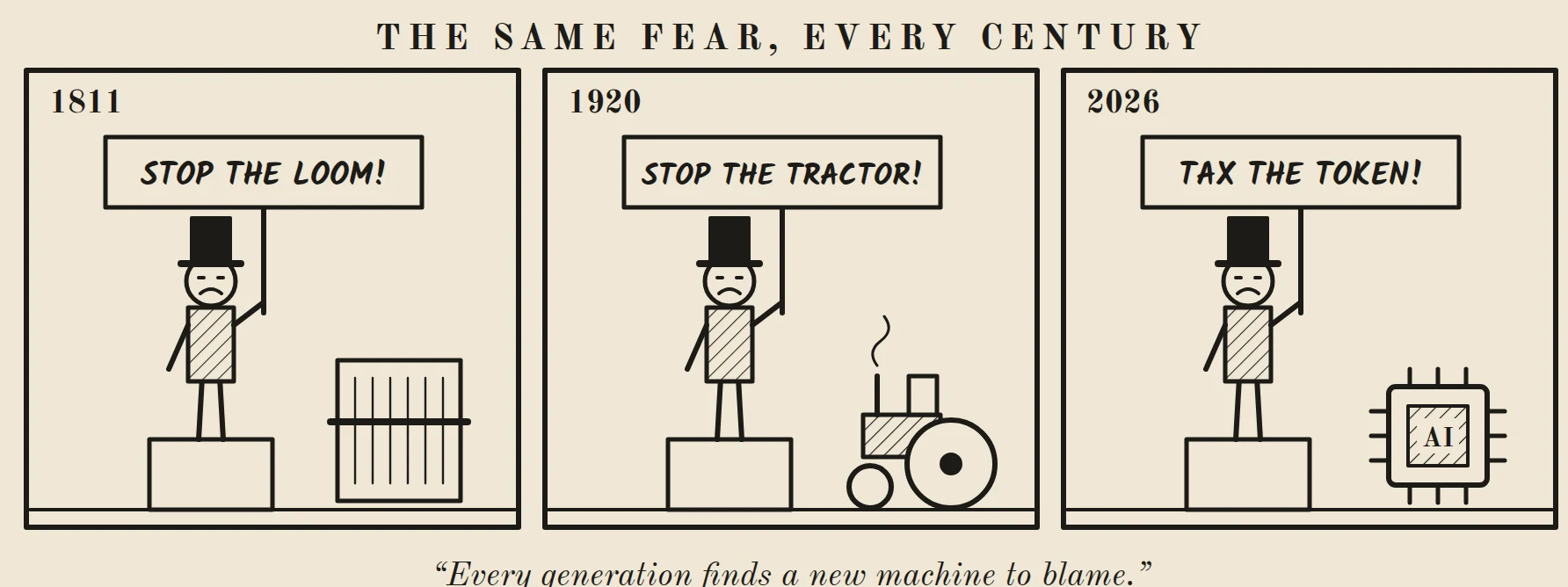
Every major tool has arrived with the same fear. When ATMs spread, people assumed bank tellers were finished. Instead, cheaper branches meant banks opened more of them, and tellers spent more time on advice and sales than on counting cash. When spreadsheets arrived, many bookkeeping clerk jobs disappeared, yet the number of accountants and financial analysts grew, because analysis suddenly became cheap enough for every business to want more of it.
Gates himself floated a "robot tax" back in 2017. Governments mostly did not adopt one, and the predicted collapse of employment did not happen. That does not mean the transition was painless for everyone. It means that taxing the machine was never the tool that decided who came out ahead.
Who decides which jobs are "human only"?
The second half of the proposal, fencing certain jobs off from AI entirely, raises an awkward question: who draws the fence, and with what knowledge? Many of the roles people instinctively want to protect are exactly the ones where AI could help the most people. In much of the world there are not enough doctors, teachers, lawyers, or translators. A family that cannot afford a lawyer, a village without a specialist, a refugee who needs a document translated tonight: banning AI from these fields does not hand them a human professional. It hands them nothing.
A list of forbidden jobs also assumes we know today what those jobs will look like in ten years. We do not. The radiologist of 2036 may spend less time staring at images and more time with patients. Freeze the job description by law and you freeze that improvement out.
The tax would push work abroad and favor the giants
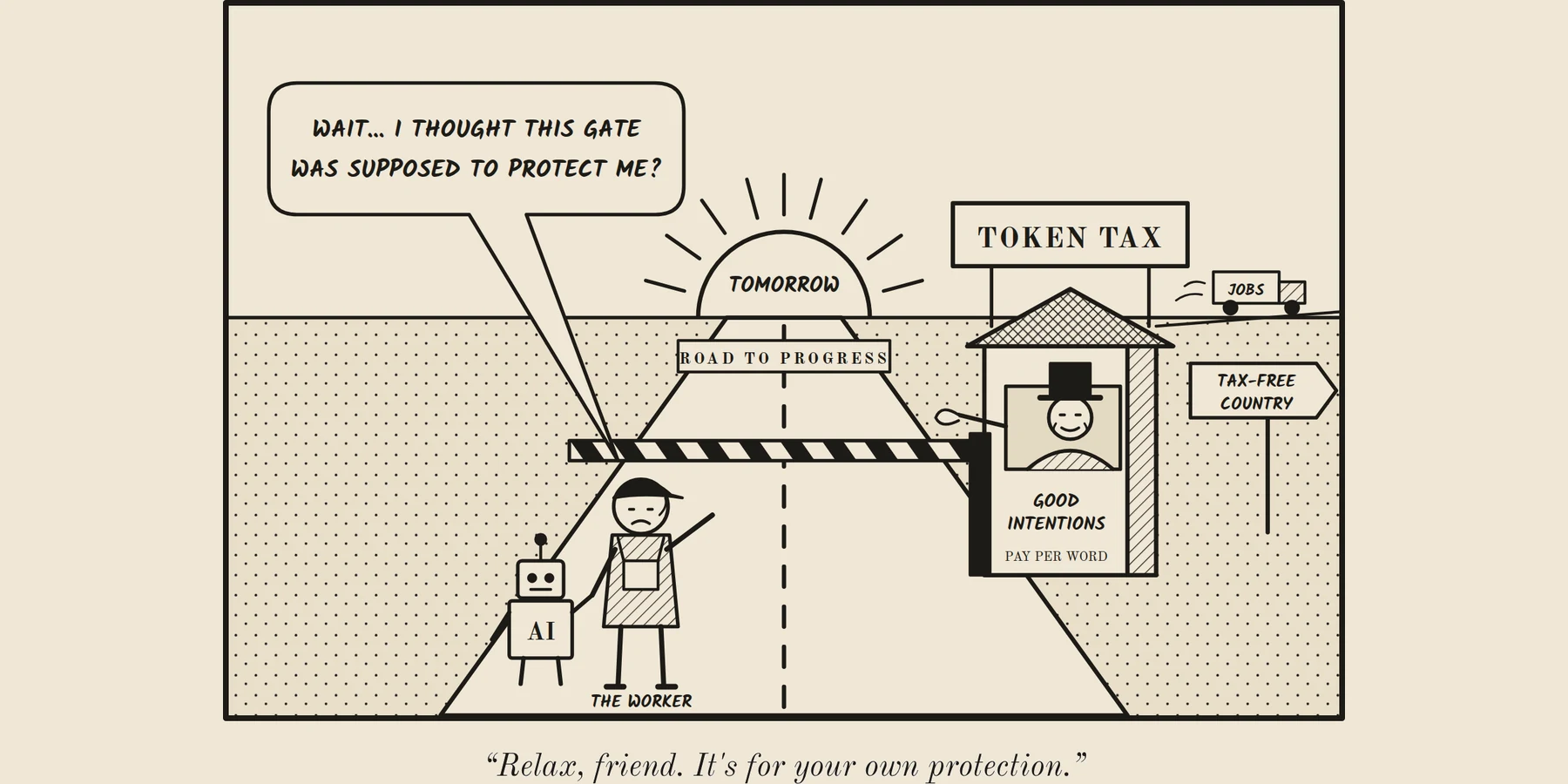
AI runs on servers that can sit in any country. If one government taxes tokens heavily, companies will buy them somewhere else. The jobs that were supposedly protected still go, and now the tax revenue goes with them. The cartoon at the top shows the truck taking the side road. That is not a joke about a distant risk. It is how capital has always responded to taxes on a single, easily moved activity.
Large firms can absorb a new tax, hire people to minimize it, and lobby for exemptions. Startups and small businesses cannot. A token tax would quietly protect the biggest incumbents from smaller competitors, and smaller competitors are where most new jobs come from.
The case in brief
- A token tax measures AI use, not job losses, so it hits clinics, students, and small firms that replaced no one.
- History shows that cheaper tools usually change jobs rather than erase work.
- Bans on "human-only" jobs deny help to people who have no human professional to turn to.
- AI work can move across borders in a day. The tax would chase it away.
- Big companies can dodge the tax. Small ones cannot.
What we should do instead
Disagreeing with Gates does not mean ignoring workers. The worry behind his proposal is real: some people will be hurt, and governments that rely on taxing wages will need other sources of revenue if wages shrink as a share of the economy. But there are better tools for both problems.
- Tax profits, not tools. If AI makes companies much more profitable, ordinary corporate and capital-gains taxes already capture that. Fix loopholes there instead of inventing a tax that cannot tell help from harm.
- Fund the worker, not the job. Portable training accounts, wage insurance for people who take a lower-paid job while they retrain, and unemployment support that follows the person rather than the employer.
- Regulate decisions, not professions. Require a named, accountable human for high-stakes calls such as medical diagnoses, court rulings, and the use of force. That keeps people responsible where it matters without banning AI from whole fields.
- Teach it early. The best protection against being replaced by a tool is knowing how to use it. Put AI skills in schools and colleges now, not after the layoffs.
Protect people, not the past
Gates deserves credit for taking the question seriously. But a token tax and a list of off-limits jobs look backward. They try to keep today's jobs in place by making tomorrow's tools more expensive. History suggests that approach fails, and that the people it fails first are the workers it was meant to save.
The road ahead will be bumpy. The answer is to help people walk it, not to build a toll gate across it.
— Gurpreet Kaur
Gurpreet Kaur is a data scientist and a student in the AI Systems Engineering Bootcamp at Modus Promethean, and writes about technology and society. More of her work: portfolio and LinkedIn. The views expressed are the author's own. The cartoons are original illustrations made for this piece in the style of early 20th-century newspaper editorial cartoons.
Related on Fire Times: The Demand Side Doesn't Forgive, on why this wave of displacement has no next sector to absorb it.
Sources
- Bill Gates, "The choices we make about AI now are critical," Gates Notes, August 2026: gatesnotes.com
- HR Executive, "Bill Gates proposes 'Human Reserved' jobs and a tax on AI": hrexecutive.com
- James Bessen, "How Computer Automation Affects Occupations: Technology, Jobs, and Skills," Upjohn Institute working paper (the ATM and bank teller figures): research.upjohn.org
- NPR Planet Money, Episode 606, "Spreadsheets!" (bookkeeping clerks down, accountants up): npr.org
- Fortune, "Bill Gates Says Robots Should Be Taxed Like Workers," February 2017: fortune.com